

WILMINGTON, Del. — Seventy-five years ago, five teenage boys walked quietly into Salesianum School and changed Delaware history.
On Nov. 14, 1950, Thomas Connell, Alfred Connell, James Owens, Fred Smith and Willie Jones — now known as the “Quintus Five” or “First Five” — became the first Black students to enroll at the all-boys Catholic high school in Wilmington. Their admission, arranged by Principal the Rev. Thomas A. Lawless, made Salesianum the first racially integrated high school in Delaware, four years before the U.S. Supreme Court struck down school segregation in Brown v. Board of Education.
Their decision did more than integrate one campus. It helped define Salesianum’s identity as a civil rights trailblazer and cemented its role as a Catholic institution committed to justice, faith and service.
A school shaped by faith and inclusion
Founded in 1903 by the Oblates of St. Francis de Sales, Salesianum was Delaware’s first Catholic high school for boys. From its earliest days, the school’s mission has been to form “Salesian Gentlemen” — young men devoted to faith, service and leadership under the motto “Live Jesus.”
When the Quintus Five enrolled in 1950, that mission was put to the test. At a time when segregation was still the norm, their quiet arrival signaled that the school’s values would not remain theoretical. By opening its doors to Black students before any legal mandate, Salesianum took a public stand that Catholic education in Delaware would be measured, in part, by its commitment to human dignity and racial equality.
Over the decades, the school has produced generations of alumni who have gone on to leadership in business, government, education and community service. Many point back to the integration of 1950 as a turning point that helped shape Salesianum’s sense of responsibility to the broader community.

James Owens ’53 (last surviving member of Quintus 5) Photo Credit: Sawyer Caldwell ’26.
Breaking barriers in Delaware education
In 1950, most schools in Delaware reflected the segregation laws and customs of the era. The decision to admit the Quintus Five into Salesianum’s student body broke that pattern.
Their presence shattered the racial barrier in Delaware’s Catholic high schools and set a precedent that rippled beyond one building on Broom Street. By integrating on principle — before court orders or political pressure — Salesianum offered an early model for how educational institutions could move toward equality.
Educators and community leaders now point to the Quintus Five as a reminder that Delaware’s story of desegregation did not begin or end in the courtroom. It also unfolded in hallways, classrooms and cafeterias, where teenagers learned, studied and played sports together in ways that had been almost unthinkable just a few years earlier.
Quiet courage, lasting leadership
Walking into a previously all-white high school in 1950 demanded courage. The climate of the time included entrenched segregation, open prejudice and resistance to social change.
Yet the Quintus Five chose to enroll, supported by their families and backed by school leadership. Their decision signaled to the wider community that Black students belonged in every classroom — not as an exception, but as equals.
That act of quiet courage has become part of Salesianum’s identity. Faculty and alumni say the story of the First Five continues to shape the school’s understanding of leadership, justice, and faith in action. It is held up as an example of how young people, simply by claiming their place, can help shift an entire community’s expectations.
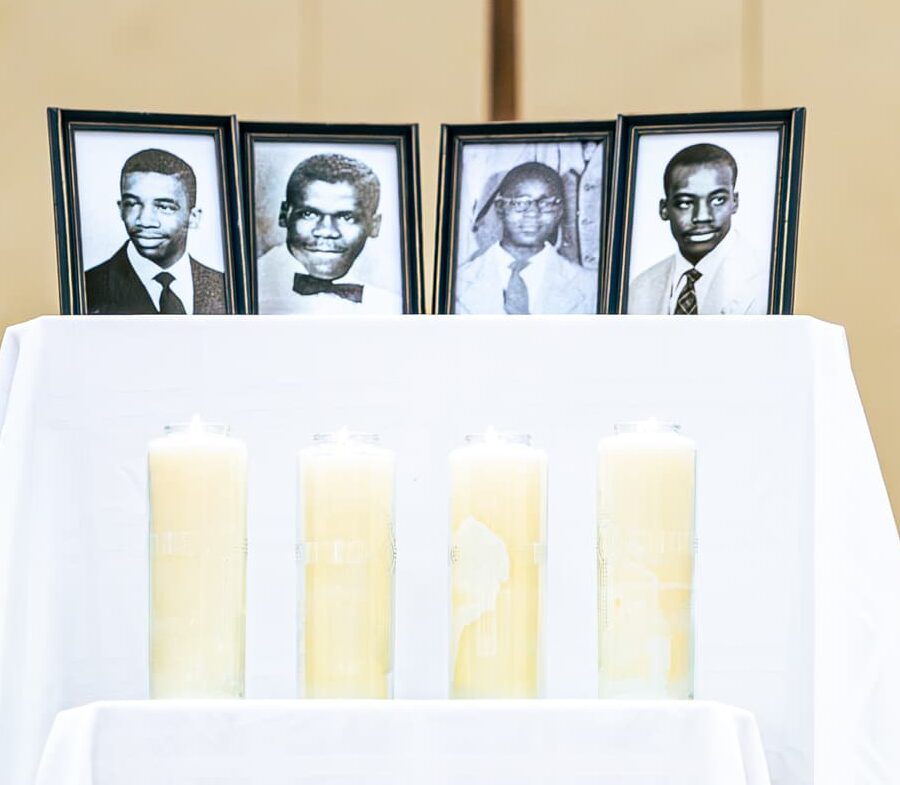
The four deceased members of Quintus 5. Photo Credit: Sawyer Caldwell ’26.
A community legacy honored 75 years later
In 2025, Salesianum and the Wilmington community marked the 75th anniversary of the milestone with a series of tributes. The celebration included formal proclamations, the unveiling of a commemorative plaque on campus and a symbolic gesture that resonated deeply with students and alumni: the retirement of the number 5 from all Salesianum athletic uniforms.
The number, once just a jersey choice, is now reserved to honor the Quintus Five and their role in integrating the school. For student-athletes, it serves as a daily reminder that the privilege of wearing a uniform is tied to a much older struggle for inclusion and dignity.
At the anniversary events, James Owens — the last surviving member of the Quintus Five — addressed students directly, challenging them to pursue excellence while treating others with respect and humanity. His message underscored the belief that academic success, athletic achievement and moral responsibility belong together.
A hub for faith, service and civic life
Today, Salesianum remains a cornerstone of Wilmington’s Catholic and civic community. The school emphasizes the spirituality of St. Francis de Sales, encouraging students to integrate faith with action through service projects, outreach, and civic engagement.
A strong culture of brotherhood connects students, alumn,i and faculty, with mentorship that extends well beyond graduation. The school frequently partners with Wilmington nonprofits, parishes, and civic organizations, reinforcing its role as a community anchor.
Salesianum also continues to invest in its future and the city’s cultural life. In 2025, the school announced a historic $20 million gift to build a new Arts and Innovation Center, expanding opportunities in creativity, technology and leadership development for students.
Serving young men in grades 9–12 from across Delaware and neighboring states, the school promotes a whole-person approach to education — balancing academics, athletics, arts, and faith formation to develop compassionate, resilient leaders. Nearly all graduates are accepted into their first-choice colleges.
Students also participate in BRIDGE trips abroad, retreat’s and service-learning programs that broaden their worldview, linking the values first tested in 1950 to challenges facing communities around the globe today.
A story taught, not just remembered
The legacy of the Quintus Five is not limited to plaques, ceremonies or a retired jersey number. Their story is woven into Salesianum’s mission and curriculum, taught as an example of how Catholic education can respond to injustice.
Teachers use their experience to help students understand the lived realities of segregation and the responsibilities that come with privilege. Student leaders and alumni often point to the First Five as a call to action — a reminder that each generation has its own work to do in advancing justice and equity in schools and neighborhoods.
For families, especially those navigating issues of race, opportunity and education, the Quintus Five stand as proof that young people can be catalysts for systemic change.
For Wilmington, their story underscores the idea that progress is not solely the result of landmark court cases or sweeping legislation. It can also begin with a single open door, a single school leader willing to take a risk and five teenagers ready to walk through together.
And for alumni, the “Salesian Gentlemen” identity — shaped by faith, service and the example of the Quintus Five — continues to inspire a lifelong commitment to justice, community and faith.
Seventy-five years after they first entered Salesianum’s front doors, the impact of Thomas Connell, Alfred Connell, James Owens, Fred Smith and Willie Jones is still unfolding. Their bravery transformed a single high school into a beacon of integration and helped define a school that remains, to this day, a leader in education, service and innovation for Wilmington and Delaware.

Delaware LIVE collaborates with a network of professional journalists to cover a diverse range of stories across various fields. Staff Writers include experienced journalists and young professionals. If you have questions, please feel free to contact editor@delawarelive.com or our publisher, George D. Rotsch, at George@Delawarelive.com

Related Posts:





Share this Post